Research Areas
My work focuses on experimental atmospheric science, with measurements spanning various laboratory scales and field locations. The air is a tremendous and complex reactor, forming from individual emissions a mixture of thousands of compounds. The interplay of these emissions, both natural and human, in the earth system leads to human health and climate impacts which are difficult to predict. The so-called molecular revolution has allowed us to capture this chemical complexity in both laboratory and field measurements. Simulating the air in the laboratory provides us one pathway for understanding how these emissions may form toxic gases or aerosols, while field measurements reveal key markers in the atmosphere and inform new experimental studies.
Nanoparticle Formation and Growth
My most recent work has focused on the formation and growth of nanoparticles, particularly derived from isoprene. I contributed to several works on isoprene oxidation and new particle formation at cold temperatures. By combining data from a wide range of gas and particle phase mass spectrometers, I was able to assess using the diagonal volatility basis set (dVBS) framework that growth of isoprene particles under low acid conditions is controlled by a small set of compounds with condense non-reactively.
Multiphase Chemistry
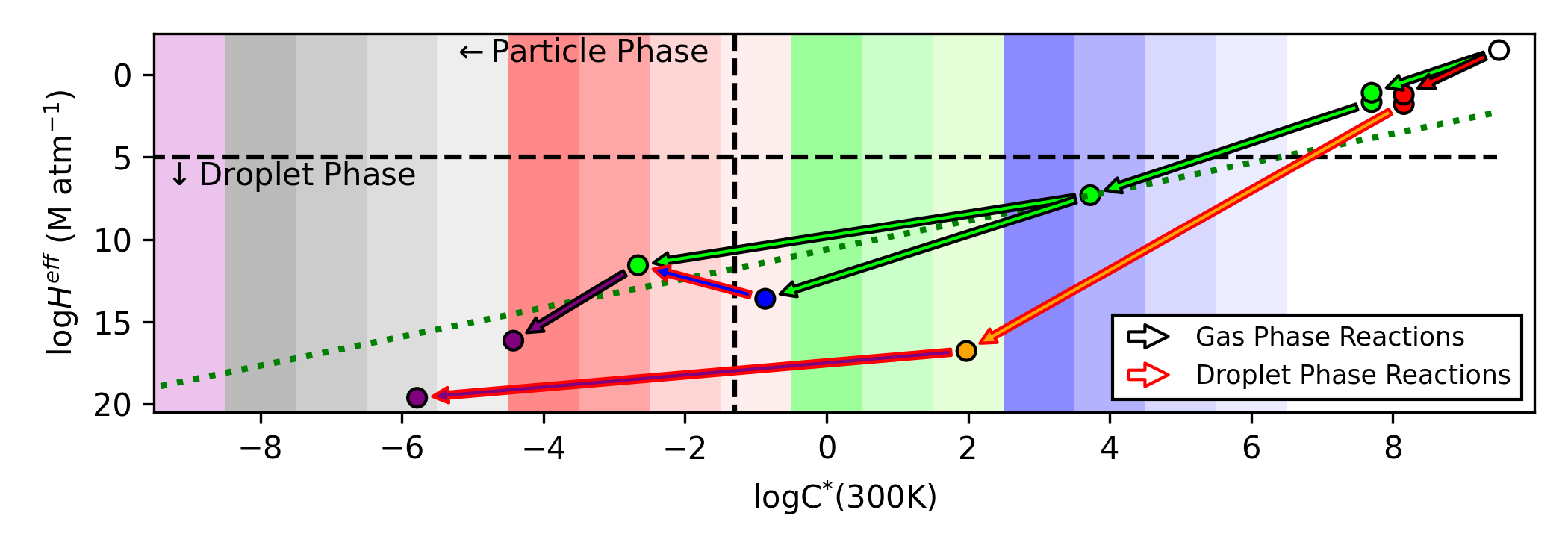 Aerosols evolve as they are transported through the atmosphere and the history of a particle population can have a strong impact on its future evolution. I have explored the impact of hydrolysis processes in isoprene aerosol and will further explore the impact of acid-catalyzed reactions on particle composition. Understanding these processes demands detailed particle chemical composition measurements, including my expertise with the Filter Inlet for Gases and AEROsols (FIGAERO) and aerosol mass spectrometer (AMS/ACSM). However, the evolution of these processes in the droplet phase will demand additional instrumentation. Furthermore, understanding uptake and reaction in droplets will require extension of the volatility basis set into solubility space and incorporation of complex aqueous phase reaction chemistry.
Emerging Contaminants
My scientific journey begain with work on organochlorine pesticides in soil, and continued in my doctoral work on inland and indoor chlorine sources and chemistry. I found that chlorine radicals form substantially different products than more abundant hydroxyl radicals and alter radical budgets. Furthermore, chlorine radical precursors can be observed far inland, formed by industrial operations. Indoors, I have found that chlorine from bleach can interact substantially with indoor surface reservoirs and expose sanitation workers to toxic vapors. Now, I continue to work on understanding pollutants in emerging areas, including high altitude biogenic oxidation products. But I continue to be extremely interested in emerging pollutants, including detection, regulation, and mitigation.